NeuroNurish.app
Low-Spoons Kitchen Console
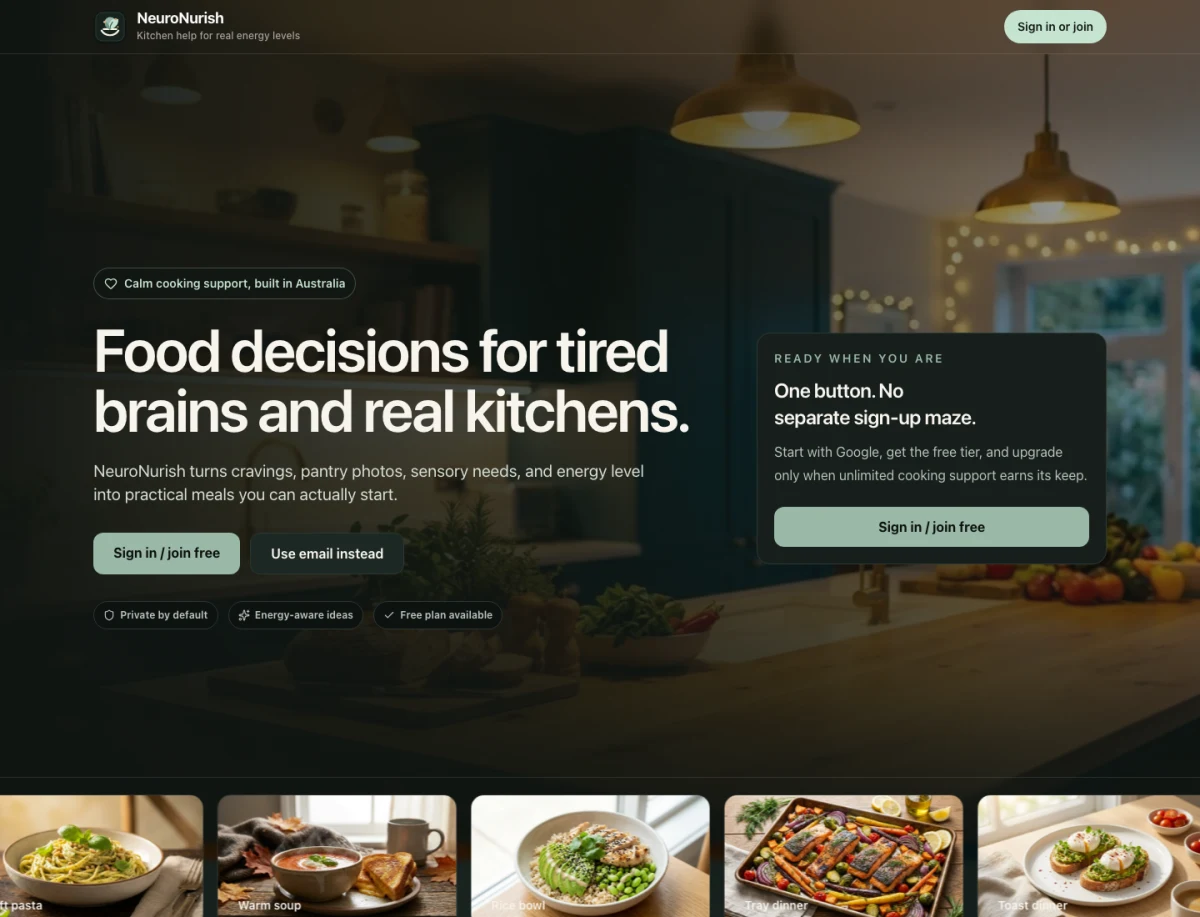
NeuroNurish started as a sensory-friendly cooking idea and has become a Cloudflare-native meal planning app for neurodivergent people who need food decisions to feel startable. The current product is an authenticated low-spoons kitchen console: pick your energy level, work from what is already in the kitchen, ask for calm cooking help, save meals, share recipes, and keep the whole thing practical rather than aspirational.
The challenge was not simply generating recipes. The app needed to respect the real constraints that make cooking hard: low energy, limited equipment, dietary needs, budget pressure, executive load, and the friction of deciding what to eat in the first place. That pushed the product away from a generic AI recipe box and toward a calm, dim, app-first workflow with persistent preferences, saved meals, quota-aware generation, and backend storage that can survive beyond a single prompt.
Stack & Architecture
- React 19 and TypeScript – authenticated app shell with route-level lazy loading
- Cloudflare Pages Functions – single REST-style API surface for auth, recipes, billing, preferences, and admin
- Workers AI – Kimi text generation and Seedream image generation centralised behind server-side adapters
- Cloudflare D1 – users, preferences, usage quotas, recipes, saved meals, and shared recipe records
- Cloudflare KV and R2 – recipe cache, share acceleration, and durable AI-generated recipe images
- Stripe – subscription checkout, billing portal, webhooks, and tier-based generation limits
App-First Product Shape
The homepage exists for entry and trust, but the real product is the authenticated dashboard. Users move between Cook, Scan, Ask, Saved, and Admin surfaces inside a dim, readable shell with a kitchen profile drawer. Preferences for intolerances, equipment, protein preference, and default servings are persisted through the API and passed into recipe generation, ingredient scanning, and meal idea prompts.
Energy-Aware AI Workflow
Recipe generation is built around energy level as a first-class input: high energy for fuller cooking, medium energy for simple assembly, and low energy for microwave, toast, no-cook, and almost-no-effort meals. The app generates meal ideas before committing to a recipe, checks caches before spending AI calls, stores generated recipes system-wide, and lets users deliberately bookmark the meals they actually want to keep.
Cloudflare-Native Architecture
The stack is deliberately Cloudflare-native: Pages for hosting, Pages Functions for the API, Workers AI for chat, recipe, image, ingredient analysis, and web-search-backed budget checks, D1 for relational state, KV for cache/share acceleration, and R2 for durable recipe images. Billing runs through Stripe checkout, portal sessions, and signed webhooks, with free, paid, full, and admin tiers enforced through backend quota checks.
Useful Cooking Support
The app goes beyond a generated recipe card. Users can upload pantry or fridge photos for ingredient scanning, chat through substitutions or simplification, run step timers with wake lock support, scale servings, estimate Australian grocery costs, save recipes, combine selected meals into a shopping list, and share public recipe pages with social metadata injected server-side.
NeuroNurish now has the bones of a real product rather than a demo: authenticated users, AI meal planning, image generation, ingredient scanning, saved meals, public sharing, quota enforcement, Stripe billing, admin visibility, and Cloudflare storage across D1, KV, and R2. The direction remains the same at heart: food help for people mainstream food tech rarely designs for with care.
Want to discuss the work?
Questions, ideas, and professional connections are welcome.